Circuit notebook / predict a signal
Tiny Logic
Follow a signal from battery and LED experiments toward transistor circuits and a CPU. Tiny Logic is Mazell's desktop electronics sandbox; use this guide to plan a first experiment and choose an edition.
Download · Creator’s site
View official Tiny Logic editionsOpens the creator’s page in a new tab. This Joywisp page is a guide; no game download or player starts here.
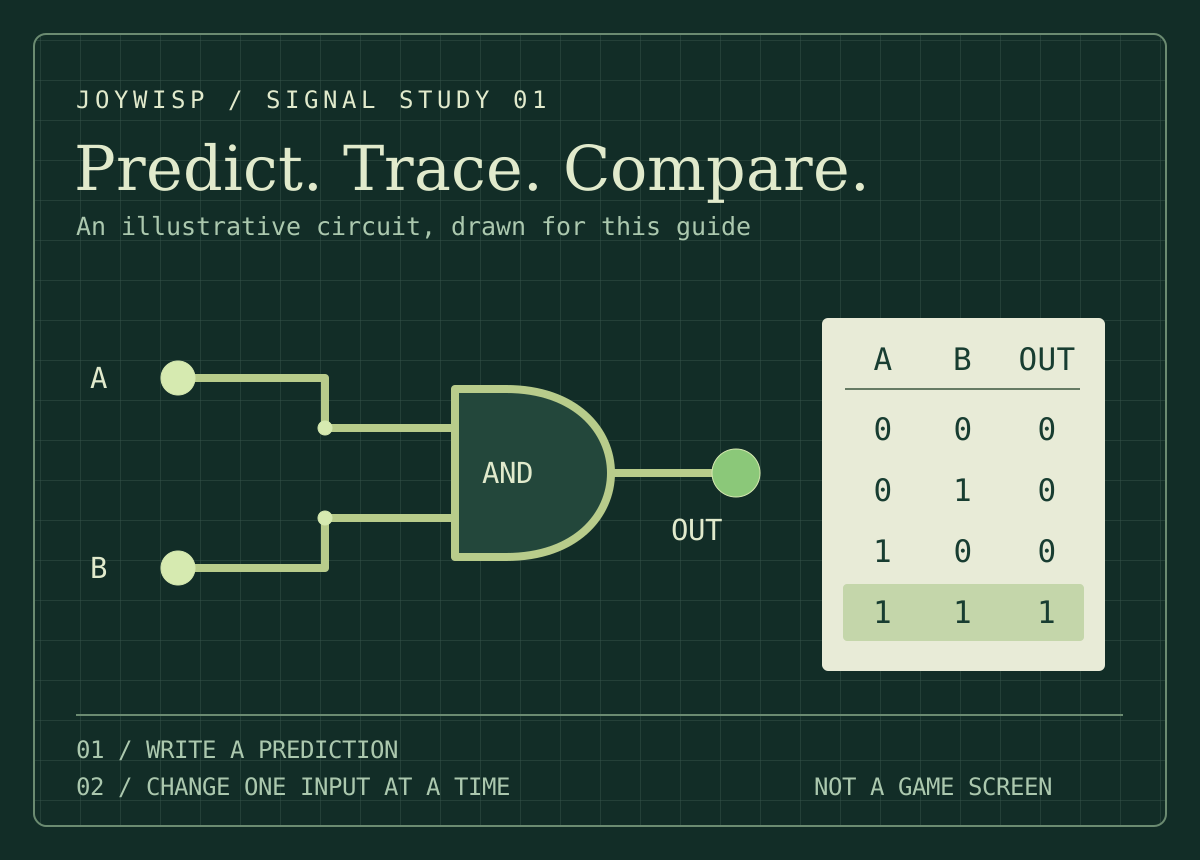
Predict one output before building
Start with a question small enough to check. For example, imagine two switches A and B and an output that should light only when both switches are on. Write four rows: 00, 01, 10 and 11; their expected outputs are 0, 0, 0 and 1. That is an AND truth table, our own preparation exercise. When following the creator's lessons, compare a circuit's observed output with your prediction, then change one input at a time. A mismatch gives you a particular signal path to inspect instead of a whole board to guess at.
Read the TINY-32 example as a system
The creator-linked tiny-logic-doom repository describes TINY-32 as an RV32IM computer with 93,338 transistors, program ROM, RAM and a screen. It attributes running DOOM to that circuit and the simulator's compiled execution; Joywisp has not benchmarked it. The useful learning distinction is between instructions stored for the processor and changing data stored during execution. Sketch where each belongs before attempting a large computer. The repository's GPL-2.0 notice concerns the DOOM source and port; it does not establish that the paid Tiny Logic application is open source.
Choose an edition for your machine
The creator recommends a 64-bit computer with 8 GB RAM, and four or more cores for larger CPUs. Linux builds require glibc 2.38 or newer. Check your system against the current project requirements, then use the listed demo to assess whether the editor and teaching approach suit you before considering the full edition. An existing project running on somebody else's machine is not a performance promise for yours. Keep the scope of your first experiment small so you can explain every input and expected output.
Keep the experiment and consent separate
The creator's linked privacy policy, version 2.1 dated October 9, says analytics start disabled and can be withdrawn in Settings. It describes analytics, crash reports and itch.io account linking as separate choices; an update check still requests public files without those optional consents. These are the publisher's policy statements, not a network audit. Read that policy from the official project page when choosing settings. Your circuit notebook can record predictions and results on paper, without depending on an analytics choice or an account link.
Creator notes & dates
Mazell’s official Tiny Logic page is the source for availability, price and the described mechanics. Checked .
- itch.io Published field
- Oct 5, 2026
- First worldwide release
- Unknown
- Found by Joywisp
Found in itch.io’s New & Popular listing with its last-seven-days filter. Listing position reflects that snapshot; it does not establish a first release in that period.
This is a source-checked guide, not a Joywisp playtest. The circuit exercise is our own learning prompt. Simulation speed, lesson progression and compatibility are untested; current price, demo limits and build requirements should be checked on the creator's page. The illustration was drawn for Joywisp. No creator screenshots, game files or playable embeds are used here. External links and privacy.